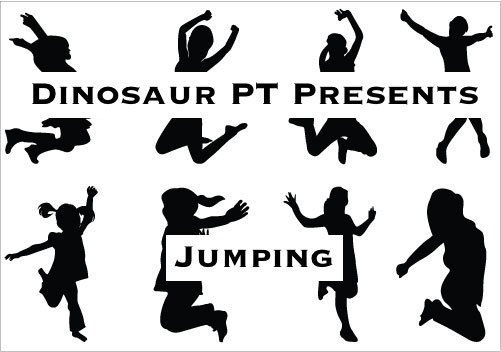

Jumping is a motor milestone that requires strength, balance, coordination, body awareness and motor planning. When practicing jumping, we wanted to make sure our children were exposed to the different environments around them, interacting with the unique textures of the ground when they were barefoot.
Practice on soft grass, cushions, carpet and hardwood. Each surface presents its own challenge for kids as they start practicing their jumps! Use other children as models, as peer play is critical for attaining motor milestones. Children observe and learn from others.
jumping milestone
- Leap forward with one foot leading: 18-24 months
- Jump in place with feet together: 22-24 months
- Jump off the small platform with two feet to land: 24-30 months
- Jump over obstacles: 30-36 months
- Jump forward with two feet off: 36 months
- Hop on one foot: 48 months
It is important not to rush every child’s skills. Jumping is done in a step-by-step fashion, with children first trying to move their weight, jumping off, jumping over, jumping up, hopping on one foot, and finally hopping on one and both legs alternately like hopscotch. All milestones happen consecutively and we can help support and encourage our children to grow and try new activities!
Teach your child to jump independently

therapy ball jump
use one therapy ball Start by placing your body in a corner or against a wall to stabilize the ball. Support your child’s hips with downward pressure as you encourage your child to bounce up and down gently. This allows for significant proprioceptive feedback from the ball to their lower body joints.

trampoline jumping
use trampoline Bringing a barbell helps kids develop independent jumping skills, recruiting upper body support until they’re ready to rely on lower body strength to propel vertically!

animal jumping
Role-play animal movements that can help infuse creative expression into the jump! Try frog hops – squat hops and bunny hops – upright vertical hops.

footprint jumping
use tactile footprint Helps to designate a colorful starting and ending location for the child. The soft texture of the footprint helps activate the intrinsic muscles of the plantar as the foot grips the ground.

platform
The jumping platform allows us to practice jumping from low places, jumping over and jumping up!we like to use foam balance beam Because it provides useful proprioceptive input, especially when barefoot. colorful spots Provides bright visual cues and facilitates narrow support bases during jumps.
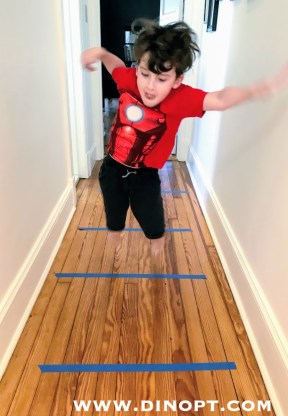
colorful tape jumping
jump over colored tape Lines are an important precursor to hurdling, providing visual cues to develop the motor planning skills needed to jump!

Hurdles
Once your child has mastered the ability to jump over the colored tape, you can start building obstacles to increase vertical height.These obstacle Great because you can gradually increase the height to challenge kids as they develop more strength, balance and control in their jumping skills! 
this colorful tactile footprints Helps with alignment of the lower body during jumping.

jumping hoop
this circle ladder A fun tool for practicing jumping, and promotes a narrow base of support as kids get motivated to place their feet inside the colorful hoops.

Ring ladders can also be used to promote sequential jumps, change configurations to teach kids jacks, and prepare for jumping scotch!
dance scotland
a bubble Jump Scotland Floor Puzzle Can be used to practice open close jumps, jumping forward and sideways as child progresses to each figure, and eventually jumping from one leg to two.
jump the red flag
Be sure to contact your pediatrician or Pediatric Physiotherapist If your child is still having trouble jumping around age 2.5-3 and you notice any of the following:
- Asymmetrical jumps (jumps from one side only)
- Push Off lacks power (can’t gain vertical clearance in jumps)
- Frequent falls (legs cannot support the child when landing and jumping)
- Anxiety or depression (showing resistance or fear of jumping prevents the child from mastering the motor skill)
Activity Ideas for Promoting Skip Reading “Fun activity…with colored spots!”