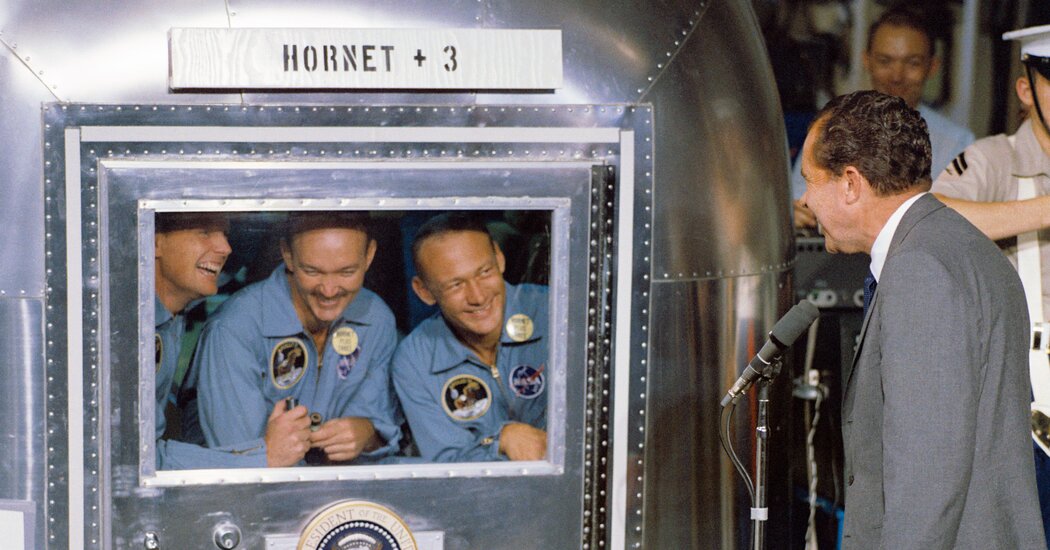
When the Apollo 11 astronauts landed on the moon in July 1969, NASA worried about their safety during the complex flight. The agency also worries about what the astronauts might bring back.
In the years leading up to Apollo 11, officials worried that the moon might harbor microbes.What would happen to lunar microbes? Survive the return trip and cause lunar fever on Earth?
In response to this possibility, NASA plans to quarantine personnel, instruments, samples and spacecraft that have been exposed to lunar material.
But in a paper published this month in the history of science journal Isis, environmental historian Dagomar de Groot of Georgetown University demonstrates that these “planetary protection” efforts are insufficient to a degree that was not previously possible. known.
“The quarantine protocol appears to have been successful,” Dr. de Groot concluded in the study, “only because it wasn’t needed.”
Dr. Degroot’s dossier work also shows that NASA officials knew Lunar bacteria could pose an existential threat (if very unlikely), and if such a threat did exist, their lunar isolation might not keep Earth safe. They exaggerate their ability to eliminate threats.
Dr de Groot’s paper says this space-age narrative is an example of the tendency of science projects to downplay existential risks that are unlikely and difficult to deal with, in favor of smaller, more probable problems. It also offers useful lessons as NASA and other space agencies prepare to collect samples from Mars and other worlds in the solar system for study here on Earth.
In the 1960s, no one knew whether the moon had ever hosted life. But scientists were so concerned that the National Academy of Sciences held a high-level meeting in 1964 to discuss lunar contamination. “They agreed that the risks were real and that the consequences could be profound,” Dr. de Groot said.
Scientists also agree that quarantining anything returned from the moon is both necessary and futile: Humans may not be able to contain microscopic threats. The best Earthlings can do is slow the release of microbes until scientists develop countermeasures.
Despite these conclusions, NASA has publicly maintained that it can protect Earth. It spent tens of millions of dollars building a sophisticated quarantine facility, the Lunar Receiving Laboratory. “But despite these beautiful complexities, there is something fundamental, fundamentally wrong,” Dr. de Groot said.
NASA officials are well aware that the lab is not perfect. Dr Degroot’s dissertation details numerous findings from inspections and tests that revealed ruptured, leaking or submerged glove boxes and autoclaves.
In the weeks following the return of the Apollo 11 crew, 24 workers were exposed to lunar materials from which the facility’s infrastructure was supposed to protect them; they had to be quarantined. Dr. de Groot wrote that the containment failure was “largely hidden from the public”.
Laboratory emergency procedures—such as what to do in the event of a fire or medical emergency—also involve breaking isolation.
“This ended up being an example of a safe war zone for planetary protection,” said Jordan Beam, a historian of science at the University of Chicago, who was not involved in Dr. de Groot’s research.
The return of the Apollo 11 astronauts also put Earth at risk. For example, their vehicle is designed to vent itself during descent, and the astronauts will open the hatch in the ocean.
In a 1965 memo, a NASA official said the agency had a moral obligation to prevent potential contamination, even if it meant changing the weight, cost or schedule of missions. But four years later, on return to Earth, the spacecraft vented anyway, and the capsule’s interior encountered the Pacific Ocean.
“If there are lunar organisms that can reproduce in Earth’s oceans, we’re screwed,” said John Rumel, a two-time NASA planetary protection officer.
The likelihood of these organisms occurring There is very little. But if they did, the consequences would be huge — the Apollo program basically accepted them on Earth’s behalf.
Dr De Groot said this tendency to downplay existential risks — rather than prioritizing more likely threats with lesser consequences — was seen in areas such as climate change, nuclear weapons and artificial intelligence.
On the Apollo missions, officials didn’t just downplay the risks; they weren’t transparent about them.
“Failure is part of learning,” Dr. Beam said of inadequate isolation.
As NASA prepares to bring back samples from Mars in the 2030s, which is more likely to host life than the moon, it’s important to know what doesn’t work.
NASA has learned a lot about planetary protection since the Apollo program, said Nick Benardini, the agency’s current planetary protection officer. It’s built conservation measures and held workshops to understand science gaps from the beginning, and it’s already working on a Mars sample lab.
The agency also plans to be candid with the public. “Risk communication and communication as a whole is very important,” Dr. Bernardini said. After all, he points out, “what’s at stake is Earth’s biosphere.”
It’s hard to imagine the biosphere being threatened by alien organisms, but the odds are not zero. “Low likelihood and high consequence risk really matter,” Dr. de Groot said. “Mitigation of them is one of the most important things governments can do.”